
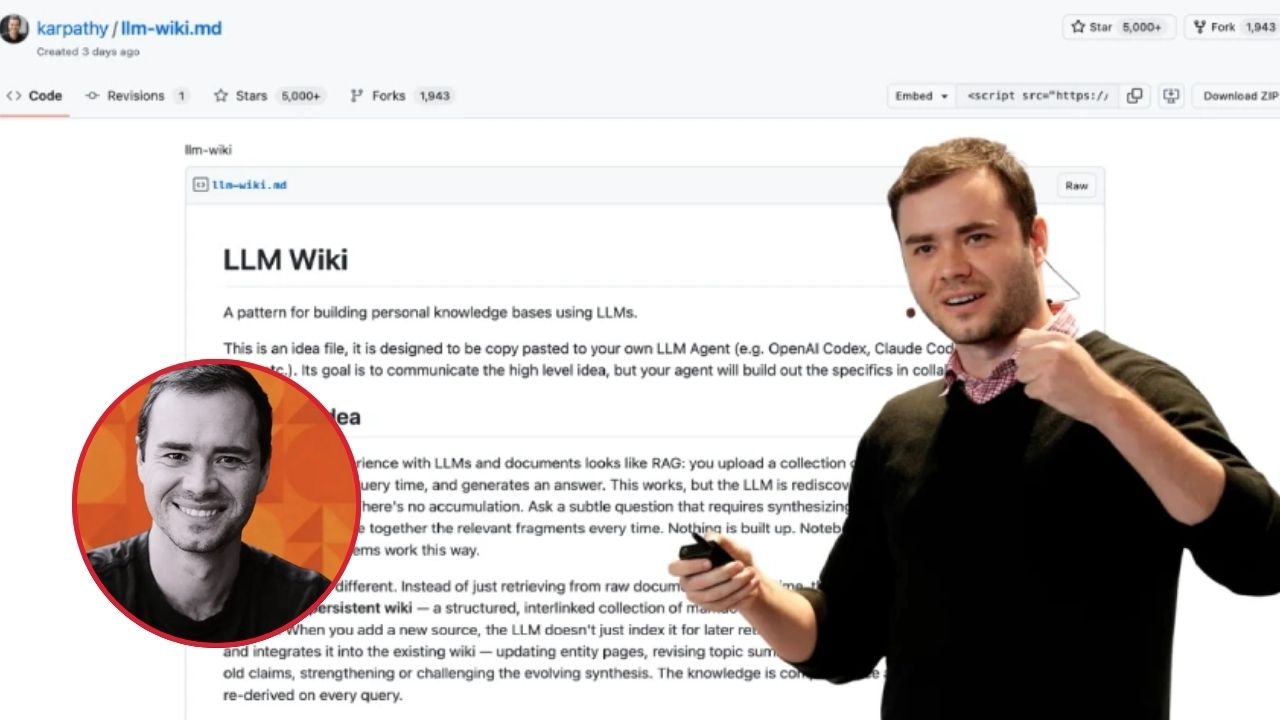
Artificial intelligence researcher Andrej Karpathy has once again become one of the most influential voices in the AI industry. This time, attention is centered around a concept known as the “LLM Wiki,” an idea that has rapidly spread through developer communities, research groups, and AI startups around the world.
The concept focuses on helping large language models organize information more intelligently over time. Instead of depending entirely on temporary prompts or fragmented retrieval systems, the LLM Wiki approach creates a structured and continuously evolving knowledge base that AI systems can understand, update, and reference more effectively.
Stick to the Facts
Add icode.net.au as a Preferred Source on Google to see more of our stories in your search results.

As discussions around AI memory and long-term reasoning continue growing, many developers now view the LLM Wiki idea as one of the most important emerging trends in modern artificial intelligence.
Who Is Andrej Karpathy?
Andrej Karpathy is widely recognized as one of the leading engineers and educators in artificial intelligence.
Born in what is now Slovakia, Karpathy later moved to Canada and studied computer science before earning a PhD at Stanford University. During his academic years, he focused heavily on deep learning, neural networks, and computer vision technologies that would later become central to the AI revolution.
He first gained widespread recognition after joining OpenAI as one of its founding research scientists. His work helped shape early advances in deep learning systems and neural network research.
Karpathy later joined Tesla, where he became the senior director of AI and Autopilot vision systems. Under his leadership, Tesla expanded its machine learning infrastructure for self-driving technology and large-scale neural network training.
In recent years, he has also become famous for simplifying complex AI topics through lectures, tutorials, and educational content. His explanations of neural networks and large language models are now widely used by students, engineers, and researchers worldwide.
What Is an LLM Wiki?
The LLM Wiki concept is designed to solve one of artificial intelligence’s biggest weaknesses: memory organization.
Modern AI systems can generate impressive responses, but they often struggle to maintain structured long-term understanding across large collections of information. Developers frequently rely on vector databases and retrieval systems to help models access stored knowledge, but those methods can become fragmented or inconsistent.
Karpathy’s LLM Wiki concept takes a different approach.
Instead of simply storing disconnected text chunks, the system organizes information into interconnected wiki-style pages. The AI continuously updates summaries, relationships, topic structures, and references as new information enters the system.
The result is a living knowledge base that behaves more like a dynamic encyclopedia than a traditional search index.
Many developers describe the idea as combining the structure of Wikipedia with the reasoning power of large language models.
Why the Idea Became So Popular
The AI community reacted quickly because the LLM Wiki concept addressed several frustrations developers already faced with modern AI tools.
Many engineers have struggled with problems such as:
- AI systems forgetting previous context
- Inconsistent retrieval results
- Hallucinated information
- Poor organization of large document collections
- Limited long-term memory
The LLM Wiki model offers a cleaner structure for handling knowledge.
Instead of forcing AI to search through massive unorganized databases every time a question appears, the system gradually transforms raw material into organized pages connected through meaningful relationships.
That structure improves readability for both humans and machines.
Developers also appreciate that the idea is relatively simple compared with some highly complicated AI memory architectures currently being explored.
How the System Works
The workflow behind an LLM Wiki usually begins with raw documents.
These documents may include:
- Research papers
- PDFs
- Notes
- Articles
- Code repositories
- Meeting transcripts
- Technical documentation
The AI reads the material and converts it into structured wiki pages containing summaries, definitions, topic maps, and linked concepts.
Instead of storing everything as isolated text embeddings, the system creates a hierarchy of related ideas.
As new information is added, the AI updates only the relevant sections of the wiki instead of rebuilding the entire knowledge system from the beginning.
This makes the structure scalable and easier to maintain over time.
Some developers compare the process to how programmers compile software projects incrementally instead of recompiling everything after every small edit.
Developers Are Building Real Projects Around It
The concept quickly inspired practical experimentation across the AI community.
Independent developers, startups, and research groups have already started building prototypes based on the LLM Wiki model.
Some projects focus on academic research databases. Others are building:
- Personal AI assistants
- Enterprise knowledge systems
- Coding documentation tools
- AI-powered research archives
- Local private memory systems
A major reason for the excitement is flexibility. The architecture can work with both cloud-based AI systems and locally hosted models.
This matters especially for companies and researchers concerned about privacy and data security.
Many developers believe structured knowledge systems like LLM Wiki could eventually become essential components of future AI assistants.
Why Karpathy’s Influence Matters
The popularity of the idea is closely connected to Andrej Karpathy’s reputation inside the AI world.
Unlike many researchers who focus only on technical publications, Karpathy has become known for explaining complicated AI systems in clear and understandable language.
His educational videos and tutorials have helped millions of people understand topics such as:
- Neural networks
- Transformers
- Deep learning
- Large language models
- AI training systems
Because he combines academic expertise with real-world engineering experience, many developers pay close attention to his ideas.
That credibility helped transform the LLM Wiki concept from a technical discussion into a widely debated trend across the industry.
Karpathy’s Return to the AI Spotlight
Karpathy recently returned to major headlines after joining Anthropic, one of the fastest-growing AI companies in the world.
Anthropic has become a major competitor in the race to build advanced language models, and Karpathy’s arrival immediately attracted attention throughout the tech industry.
Many analysts believe his experience at OpenAI, Tesla, and in AI education gives him unusual influence across multiple areas of artificial intelligence development.
His involvement in future AI systems could shape how next-generation models handle reasoning, memory, and knowledge organization.
Why LLM Wiki Could Matter for the Future
The growing popularity of LLM Wiki reflects a larger shift happening across artificial intelligence.
Developers no longer want AI systems that only respond to temporary prompts. Increasingly, they want assistants capable of maintaining organized long-term understanding.
That requires better memory systems.
The LLM Wiki approach represents one possible solution by combining structured organization with AI reasoning capabilities.
Even if the exact architecture evolves over time, the underlying idea has already changed how many researchers think about AI knowledge management.
As AI systems continue becoming more advanced, concepts like LLM Wiki may eventually play a major role in how future assistants learn, remember, and organize information for both businesses and everyday users.