
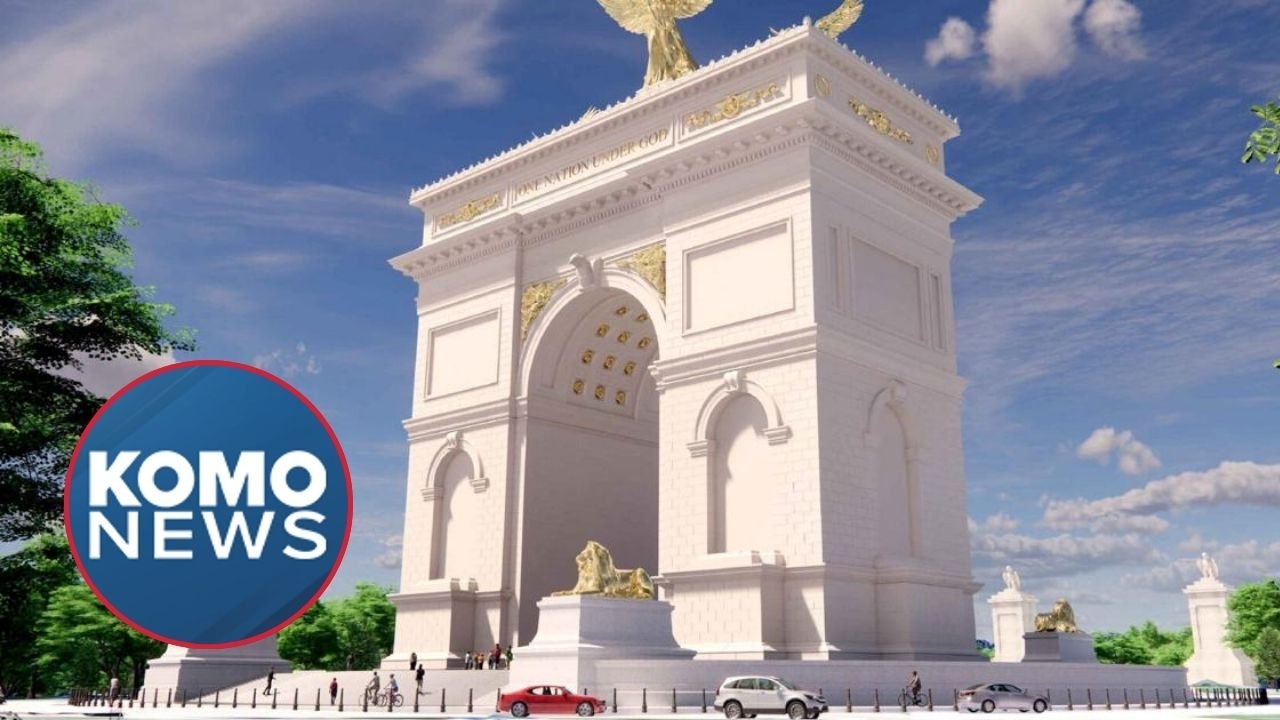
President Donald Trump’s ambitious plan to construct a towering triumphal arch in Washington, D.C., has moved into a new phase after federal officials advanced the project without seeking fresh approval from Congress. The proposal, which supporters describe as a landmark celebration of America’s 250th anniversary, has triggered legal battles, political criticism, and a broader debate about executive power.
The 250-foot monument, often referred to by critics as the “Arc de Trump,” is intended to stand near Arlington National Cemetery at Memorial Circle, creating a dramatic new feature on the capital’s skyline. While Trump allies argue the project fulfills a century-old vision for the site, opponents contend that the administration is attempting to bypass established legal requirements.
Stick to the Facts
Add icode.net.au as a Preferred Source on Google to see more of our stories in your search results.

A Monument Designed for America’s 250th Birthday
The proposed triumphal arch is part of a larger effort by the Trump administration to reshape and beautify Washington ahead of the nation’s 250th anniversary celebrations.
According to project plans, the structure would rise 250 feet above Memorial Circle, symbolizing the 250 years since the Declaration of Independence was signed in 1776. Design renderings include a torch-bearing statue inspired by Lady Liberty, gilded eagles, patriotic inscriptions, and a public observation deck offering panoramic views of the capital region.
Trump has repeatedly promoted the arch as a transformative addition to Washington, arguing that many major world capitals feature monumental arches while the United States lacks a comparable structure. Supporters say the project would honor military sacrifice, national achievement, and American history.
The Congressional Approval Dispute
The most controversial aspect of the project involves how the administration intends to proceed.
Under longstanding federal rules, significant monuments on protected federal land in Washington generally require congressional authorization. Critics argue that Memorial Circle falls under those protections and that Congress must explicitly approve construction before any work can begin.
Administration officials, however, maintain that a new congressional vote is unnecessary.
Their argument relies on a federal planning report approved by Congress in 1925 during the development of the Arlington Memorial Bridge. That historic proposal included plans for monumental structures near Columbia Island that were never built. Trump officials claim the current arch fulfills that earlier authorization and therefore does not require additional approval from lawmakers.
The legal interpretation has become one of the central issues in the growing controversy.
Federal Panel Approves Design
Despite public objections, the U.S. Commission of Fine Arts recently approved revised designs for the project.
The commission, whose members were appointed during the Trump administration, endorsed modifications that removed several elements from earlier concepts while retaining the overall scale and appearance of the monument. The updated design continues to feature patriotic imagery, gold-lettered inscriptions, and a large viewing platform.
Approval by the commission does not automatically authorize construction, but it represents a significant milestone in the review process.
The project is expected to face additional consideration from other federal planning bodies before final decisions are made.
Critics Call the Plan an Overreach
Opposition to the arch extends beyond political rivals.
Veterans groups, preservation organizations, historians, and legal advocates have all raised concerns about the proposal. Several lawsuits argue that the administration lacks authority to proceed without congressional approval and that the monument would alter one of the nation’s most historically significant landscapes.
Critics particularly object to the location.
Memorial Circle sits along a prominent visual corridor connecting Arlington National Cemetery and the Lincoln Memorial. Opponents say the massive structure would disrupt historic sightlines that have remained largely unchanged for decades.
Some legal experts have also questioned whether a century-old authorization can reasonably be interpreted as approval for a completely different modern project.
Survey Work Already Underway
Although full construction has not started, activity at the proposed site has increased.
Workers recently conducted surveys and geotechnical testing at Memorial Circle, placing markers and performing preliminary engineering evaluations. Federal officials described the work as part of the planning process rather than actual construction.
For opponents, however, the surveys signal the administration’s determination to move forward despite ongoing legal challenges.
The preparations have intensified concerns that construction could begin quickly if courts decline to intervene.
Part of a Larger Washington Transformation
The triumphal arch is not the only high-profile project associated with Trump’s vision for the capital.
The administration has also promoted plans for a National Garden of American Heroes, renovations to the Lincoln Memorial Reflecting Pool, and a major ballroom expansion at the White House. Together, these initiatives form a broader effort to reshape Washington’s appearance ahead of the semiquincentennial celebrations.
Supporters view the projects as investments in national pride and tourism. Critics argue they represent expensive and politically motivated changes to historic public spaces.
Legal Challenges Continue
Court battles are expected to determine whether the administration’s strategy can succeed.
Attorneys representing veterans and preservation groups contend that the project violates federal procedures governing monuments and public land. Their lawsuits seek to halt construction until Congress formally authorizes the arch and additional environmental and historical reviews are completed.
Meanwhile, administration officials remain confident that their interpretation of the 1925 authorization will withstand scrutiny.
With planning reviews advancing and site preparations underway, the dispute has become one of the most closely watched battles over Washington’s future landscape.
What Happens Next?
The future of the triumphal arch remains uncertain, but momentum behind the proposal continues to build.
Federal review panels have approved key design elements, surveys have begun at the site, and the administration continues to defend its authority to proceed without congressional action. At the same time, lawsuits and political opposition show no signs of disappearing.
Whether the monument ultimately rises above Memorial Circle or becomes another chapter in Washington’s long history of controversial development battles, the project has already sparked a national conversation about presidential power, historic preservation, and how America chooses to commemorate its past.